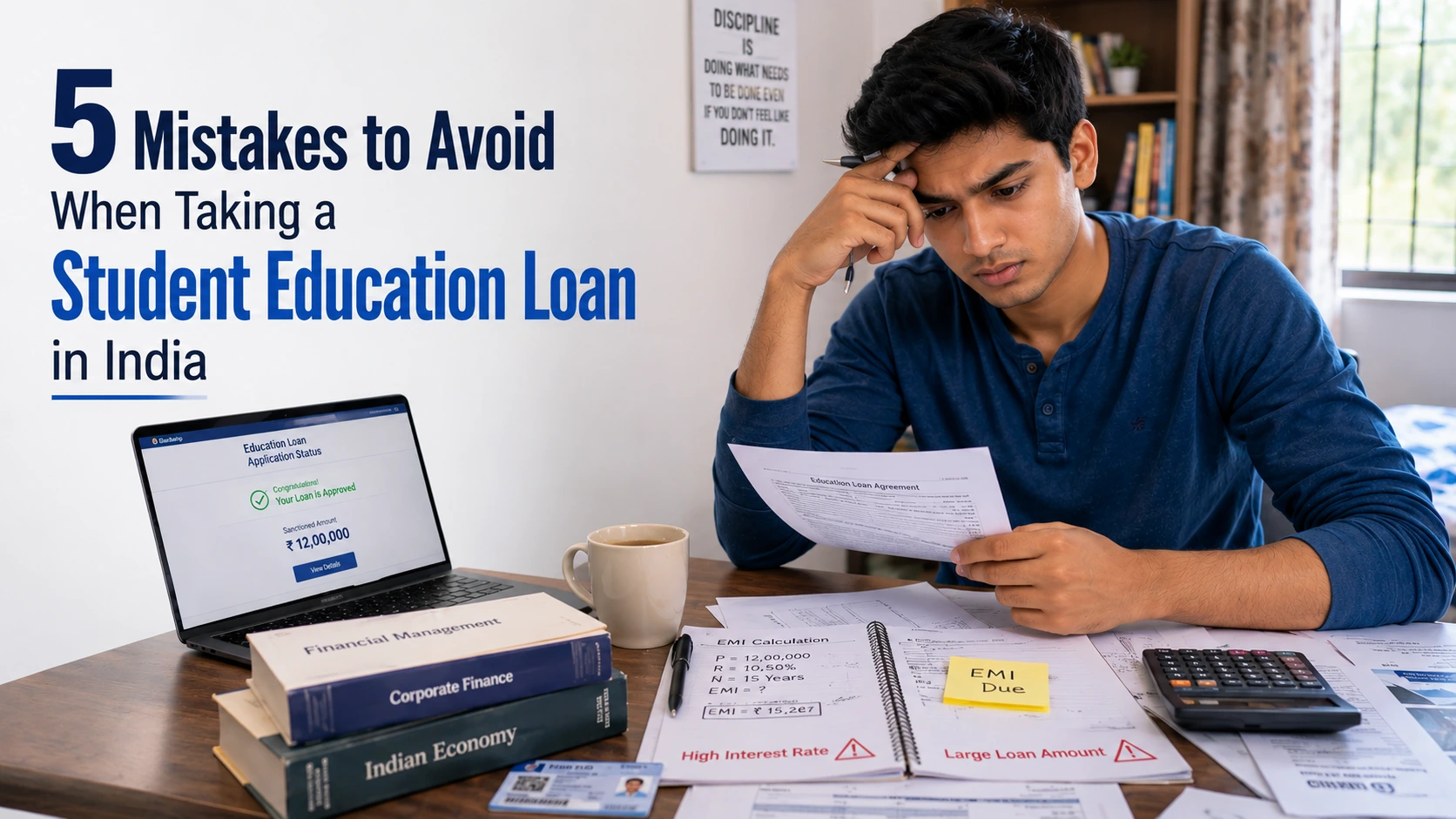
Taking out a student education loan in India can be a good decision, but only if you understand it properly. A loan isn’t free money. It’s money that you’ll have to pay back with interest later. Many students take out education loans because they want to attend a good college, pursue higher education, or study abroad. This is fine. But the real problem begins when students and parents take out loans without planning.
In India, students can apply for education loans through banks and official portals like PM-Vidyalaxmi, a unified education loan application portal supported by government departments, the Indian Bank for Educational Research (IBA), and banks.
But the truth is taking a loan is easier than repaying it. So, before signing any loan papers, you should understand the interest rate, repayment period, moratorium, collateral, course value, and your future earning potential.
This article explains in simple English the 5 biggest mistakes to avoid while taking a student education loan in India.
What is a student education loan?
A student education loan is money borrowed from a bank or financial institution for education. This can include college fees, hostel fees, books, laptops, exam fees, travel expenses for studying abroad, and other study-related expenses.
Simply put, the bank covers the cost of your education today, and you repay it after completing your course. Most education loans come with a moratorium period, which means you typically don’t have to start paying the full EMI immediately during your studies.
But don’t get it wrong. Even if EMIs start later, interest can still accrue throughout your studies. This is where many students face setbacks later.
Education loans are useful, but they should be treated as a serious financial decision. You’re not just choosing a college. You’re choosing a financial responsibility for the next few years of your life.
Mistake 1: Taking a loan without comparing banks
The first big mistake is taking a loan from the bank that says “yes” first. Many students go to a bank, ask for an education loan, and accept whatever interest rate or terms they get. This is not the right approach.
Different banks may offer different interest rates, processing fees, repayment periods, margin money terms, and collateral requirements. Even a small difference in interest rates can save or cost you thousands of rupees over the entire loan term.
For example, if one bank offers a loan at 10.5% and another at 9.2%, the difference may seem small today. But 7-10 years down the line, that small difference can become a significant amount.
You should compare:
- Interest rates
- Processing fees
- Repayment period
- Moratorium rules
- Collateral requirements
- Prepayment charges
- Co-applicant rules
- Insurance charges
Don’t just ask, “Loan milega kya?” Ask, “Total cost kitna padega?”?”
Mistake 2: Borrowing More Money Than You Need
Many students think, “Since the bank is offering a loan, let’s take the full amount.” This thinking is dangerous.
You should only borrow as much as you truly need. A larger loan means higher interest, higher EMIs, and more pressure after graduation. An education loan should support your career, not become a burden on you.
Before taking out a loan, make a simple expense list:
- College tuition fees
- Hostel or room rent
- Food expenses
- Books and study materials
- Laptop or tools
- Travel expenses
- Emergency amount
Then subtract your savings, scholarships, family support, or part-time income. The remaining amount should be your actual loan requirement.
Let’s say your entire course cost ₹8 lakh, but your family can manage ₹2 lakh and you can get a scholarship of ₹1 lakh. So you might only need ₹5 lakh, not ₹8 lakh.
A loan is like carrying a bag on your back. Carry what you need, not a heavier load just because someone offered it.
Mistake 3: Ignoring the Moratorium and Repayment Rules
This is one of the most common mistakes. Students hear the word “moratorium” and think, “No EMIs during your studies, so that’s fine.” But the hidden element is interest.
The moratorium period is the time when you don’t have to pay EMIs. Typically, this includes the course period and a few extra months after completion. However, depending on the bank and loan terms, interest may be calculated during this period as well.
So, if you take out a loan of ₹7 lakh and don’t pay any interest during your studies, your total loan amount could increase by the time repayment begins.
Before taking out a loan, ask the bank:
When will EMIs start?
Will simple interest be charged during your studies?
Can I pay interest during the moratorium?
What if I don’t find a job soon?
Can the repayment period be extended?
If possible, paying a small amount of interest during your studies can reduce future burden. In some cases, even ₹1,000–₹3,000 per month can help.
Don’t neglect repayment planning. EMIs will also be due after your degree.
Mistake 4: Not Reading Loan Terms Properly
Many students and parents sign loan documents without fully reading them. This is a very risky mistake.
Loan documents may contain important details about interest rate types, collateral, guarantors, late payment charges, insurance, margin money, and repayment terms. If you don’t read these carefully, you could face problems later.
In India, education loans up to certain limits may have collateral-free options under specific schemes and eligibility conditions. The RBI has stated that banks should not require collateral for education loans up to ₹4 lakh. The government also states that under model education loan schemes, no collateral or third-party guarantee is required for loans up to ₹7.5 lakh, if eligible under related schemes like CSIS/CGFSEL.
However, rules can vary depending on bank policy, loan amount, course, institution, and eligibility. So never assume. Always confirm in writing.
Check these before signing:
- Fixed or floating interest rate
- Collateral requirement
- Co-applicant responsibility
- Processing fee
- Insurance fee
- Late payment penalty
- Prepayment rules
- EMI start date
- Total repayment amount
If you don’t understand any point, ask a bank officer to explain it. There’s no shame in asking. The shame lies in signing blindly.
Mistake 5: Choosing a course without checking the job scope
This is the biggest practical mistake. Students sometimes take out a large education loan for a course without checking the job opportunities, salary range, placement record, or industry demand.
An education loan isn’t just for admission. It’s an investment in your future earnings.
Before taking out a loan, check:
- Does the college have genuine placement records?
- What is the average salary after completing this course?
- Are companies hiring from this college?
- Is the course relevant in the market?
- Can you afford the EMIs with the expected salary?
- Is the college accredited?
- Are there any cheaper and better alternatives?
For example, taking out a loan of ₹20 lakh for a course where the average salary is ₹3 lakh per year can be stressful. But taking a loan of ₹6 lakh for a course that offers good placements and an average package of ₹6–8 lakh may be more practical.
Don’t choose a course just because it sounds fancy. Choose it because it can help you build a real career.
Final Checklist Before Taking an Education Loan
Before applying, use this simple checklist:
- Compare at least 3 banks
- Check the interest rate and total repayment amount
- Borrow only the required amount
- Understand moratorium rules
- Ask about interest rates while studying
- Read all loan documents
- Check collateral and guarantor requirements
- Verify college placement records
- Calculate future EMIs
- Have an emergency backup plan
If you can’t explain your loan in simple terms, you probably haven’t understood it well enough yet.
Conclusion
A student education loan can open the door to a better future, but only if it’s taken carefully. The loan itself isn’t the problem. The problem is poor planning.
Avoid these 5 mistakes: not comparing banks, borrowing too much money, ignoring repayment terms, signing without reading the terms, and choosing a course without considering the job scope.
Think of it this way: Your education loan should be a bridge to your career after graduation, not a trap.
Take your time. Ask questions. Compare options. Read the documents. Then decide.
FAQs
Is education loan good for students in India?
Yes, it can be good if the course has strong career value and the student understands repayment properly.
Can I get an education loan without collateral?
Collateral-free education loans are available under certain limits and eligibility rules. RBI has mentioned no mandatory collateral up to ₹4 lakh, and government information also refers to collateral-free support up to ₹7.5 lakh under eligible schemes.
Should I pay interest during study period?
If possible, yes. Paying interest during the study period can reduce your total repayment burden later.
What is the biggest education loan mistake?
The biggest mistake is taking a loan without checking future salary, course value, and repayment capacity.
Where can students apply for education loans online?
Students can apply through the PM-Vidyalaxmi portal, which is a unified portal for education loan applications.